
Share





Published on: 06/03/2026Updated on: 30/06/2026
In France, around 1 million individual employers hire a childcare provider or a family assistant to care for their children¹. These professionals represent the leading form of individual childcare for young children in the country.
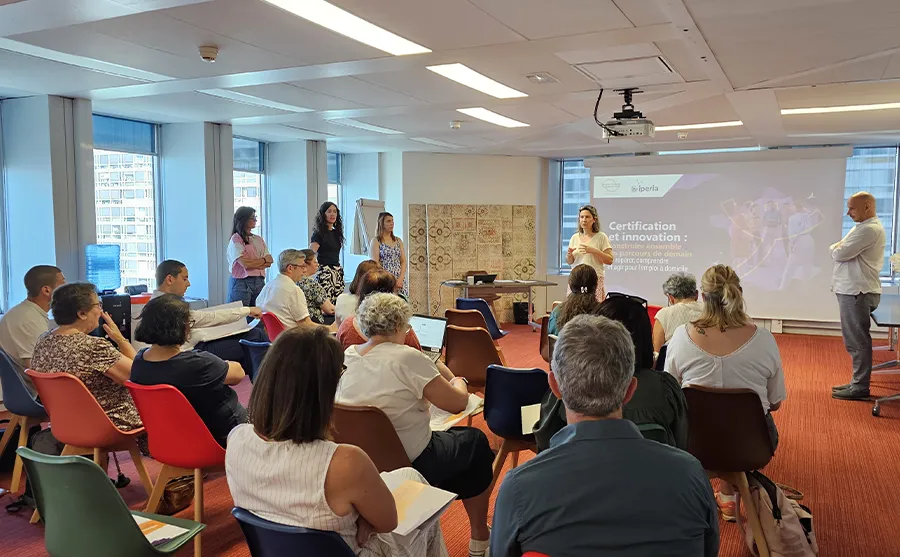
In a context marked by recruitment challenges, increasing expectations around the quality of care, and strong societal demands regarding child development, the issue of skills certification has become central. Here is an overview.
In a context marked by recruitment challenges, increasing expectations around the quality of care, and strong societal demands regarding child development, the issue of skills certification has become central. Here is an overview.
Early childhood: a public policy priority
In France, there were 1.9 million children under the age of three as of 1 January 2025². The quality of their care is now a key pillar of public policy: equal access to childcare services, quality requirements, inclusion, prevention of vulnerabilities and attractiveness of professions.
The quality of care is largely delivered at home, as individual childcare remains the primary formal care solution for children under three. It is provided by 236,430 childcare providers and 101,620 in-home childcare assistants¹.
A sector mobilised for over 30 years
Within home-based employment, quality relies on a long-term sector-wide strategy.
For more than 30 years, the individual employers sector has developed a proactive professionalisation policy, anticipating societal challenges linked to early childhood:
- Creation of professional certifications (for childcare providers and in-home childcare assistants)
- Development of job-specific frameworks adapted to home-based care
- Expansion of continuing vocational training
- Recognition of prior learning and experience (VAE)
- Personalised support through career and guidance advisors (COEPS)
A delegated mission: structuring professionalisation at national level
To implement this ambition, the sector has mandated IPERIA, the professionalisation platform for the individual employers and home-based employment sector.
Its mission is to design competency frameworks, structure career pathways, organise training provision, deliver recognised certifications and support (future) professionals.
IPERIA acts as an operational link in a chain of trust built around skills:
Competency frameworks → Training → Assessment → Certification → Professional recognition → Families’ trust
Certification is not only about training. It formally recognises professional know-how: supporting child development, ensuring safety, cooperating with employer parents, and adapting care to specific situations (disability, special needs, atypical schedules).
Concrete impacts on professionals’ and families’ lives
Behind the systems are real career journeys. Certification has a tangible impact on the professional trajectory of childcare providers and in-home childcare assistants, as well as on self-confidence, relationships with families and the attractiveness of the profession.This is reflected in the testimony of Véronique, a childminder:
“The more our profession becomes professionalised and recognised, the easier it becomes for childcare providers to showcase the full scope of our skills, responsibilities and missions in supporting children’s development.”
For Fanny, certification also strengthens professional confidence:
“During my first in-home childcare contract, I felt undervalued by my employer, who said: ‘no diploma proves your skills’. Thanks to my qualification, I gained confidence when applying for jobs (…) I feel more secure in my profession and can progress more effectively.”
Certification as a way to secure the future
Faced with demographic, social and economic challenges, early childhood has become a cornerstone of public policy. In home-based employment, the stakes are significant: 42% of childminders are expected to retire by 2035¹, and more than 122,000 positions¹ will need to be filled in early childhood care.
Certifying skills is not about adding an extra constraint. It is about ensuring the quality of care and support, strengthening the attractiveness of occupations, structuring the home-based employment sector, and providing public decision-makers with an operational lever to steer their policies.
Skills certification represents a collective investment in the service of children, families and society.
1 Home-based Employment Observatory, June 2025
2 “Childcare for young children”, 2025 edition, National Early Childhood Observatory (ONAPE)
2 “Childcare for young children”, 2025 edition, National Early Childhood Observatory (ONAPE)