Share





Published on: 26/06/2026Updated on: 03/07/2026
Listening, dialogue and close collaboration: over the course of a month, IPERIA brought together its partner training organisations across France. These collaborative working sessions, focused on certifications, skills and personalised career pathways, illustrate how the professional branch's delegated mission for the individual employer and home-based employment sector is put into practice—working hand in hand with the professionals who deliver training.
A Sector in Motion, Certifications That Anticipate Change
The individual employer and home-based employment sector is no longer simply adapting—it is anticipating change. Occupations are evolving, the people supported are becoming increasingly diverse, and families' needs are growing more complex. Today's Family Assistant is no longer quite the same as yesterday's, expected to support both families with children and more isolated individuals. For Care Assistants, the relational and communication aspects of the profession have become far more prominent than they were five years ago: understanding the individual employer, supporting people at the end of life, and working within increasingly complex care situations. Childminders, meanwhile, are more frequently supporting children with disabilities as part of their everyday practice.
It is precisely to respond to these transformations that certifications continue to evolve. The six certifications registered in the Specific Register (RS) and the three RNCP professional qualifications recently renewed by France Compétences demonstrate this commitment. Beyond the renewals themselves, the entire certification framework is being modernised: Dependency Care Assistant becomes simply Care Assistant; Childcare Worker evolves into Home Childcare Assistant; and complementary certifications are now designed to benefit professionals across all occupations within the sector.
Particular attention should also be paid to the Home Environment Maintenance Assistant professional certificate, which corresponds approximately to an EQF Level 2 qualification. Designed as an entry point into the sector, it is primarily intended for people furthest from employment, offering a concrete pathway into home-based professions through targeted support and progression routes towards further certifications. Currently being piloted across France in partnership with France Travail, it reflects both the European Union's commitment to recognising skills at every level and a tangible labour market need: in Brittany alone, for example, nearly 40,000 positions are expected to be filled by 2030.
Particular attention should also be paid to the Home Environment Maintenance Assistant professional certificate, which corresponds approximately to an EQF Level 2 qualification. Designed as an entry point into the sector, it is primarily intended for people furthest from employment, offering a concrete pathway into home-based professions through targeted support and progression routes towards further certifications. Currently being piloted across France in partnership with France Travail, it reflects both the European Union's commitment to recognising skills at every level and a tangible labour market need: in Brittany alone, for example, nearly 40,000 positions are expected to be filled by 2030.
Tailor-Made Pathways: A New Approach to Career Support
One of the most significant developments concerns the way professionals are supported throughout their careers. To respond to increasingly diverse profiles and labour market needs that vary across regions, IPERIA is evolving its Orientation & Career Development offer towards more personalised support. Modular pathways, enriched with digital resources and employment workshops, are co-designed with each participant to help clarify career goals, recognise existing skills and support professional development.
This transformation is embodied by a new role: the Sector-specific Career Guidance and Professional Development Advisor (COEPS), who combines individual guidance, group workshops and flexible learning modules. Connections between certifications are also being strengthened. How can transitions from one occupation to another be made easier? How can the skills of professionals who have worked for many years without formal certification be recognised? Recognition of Prior Learning (VAE) remains a key pathway. For example, some childminders, facing declining childcare demand, are progressively transitioning into care assistant roles. These professional journeys cannot simply be prescribed—they are built step by step.
This transformation is embodied by a new role: the Sector-specific Career Guidance and Professional Development Advisor (COEPS), who combines individual guidance, group workshops and flexible learning modules. Connections between certifications are also being strengthened. How can transitions from one occupation to another be made easier? How can the skills of professionals who have worked for many years without formal certification be recognised? Recognition of Prior Learning (VAE) remains a key pathway. For example, some childminders, facing declining childcare demand, are progressively transitioning into care assistant roles. These professional journeys cannot simply be prescribed—they are built step by step.
Regional Meetings to Build the Future Together
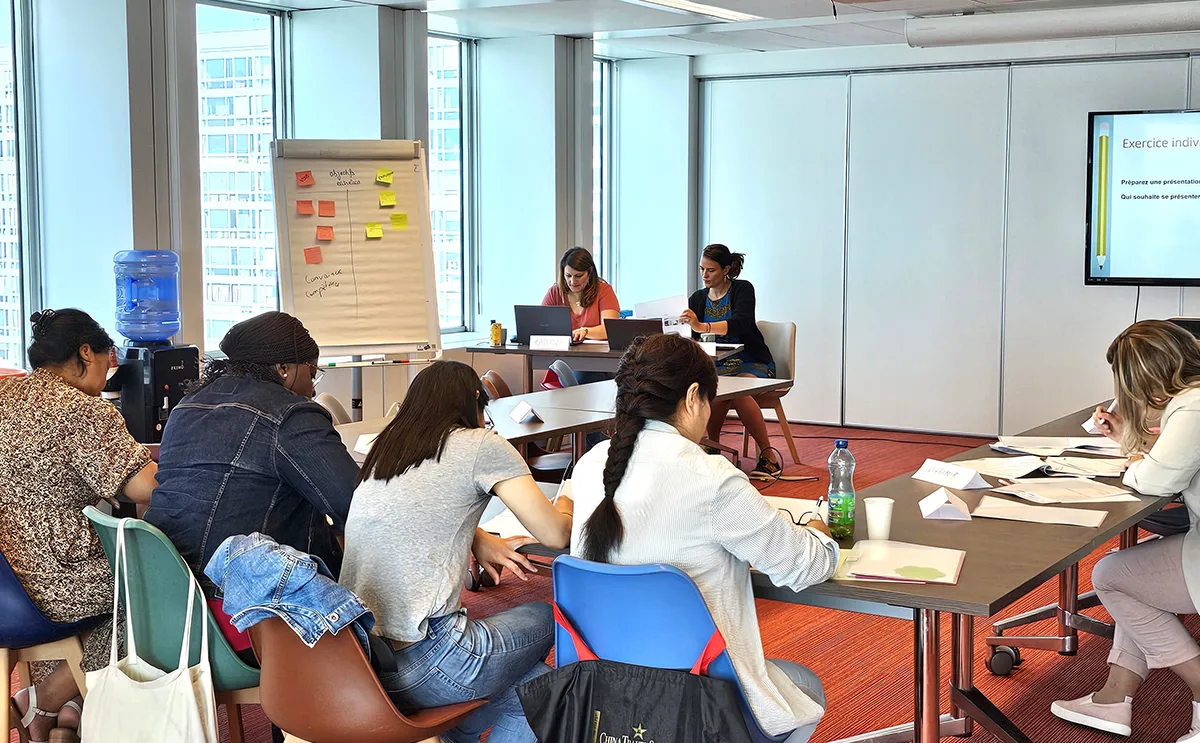
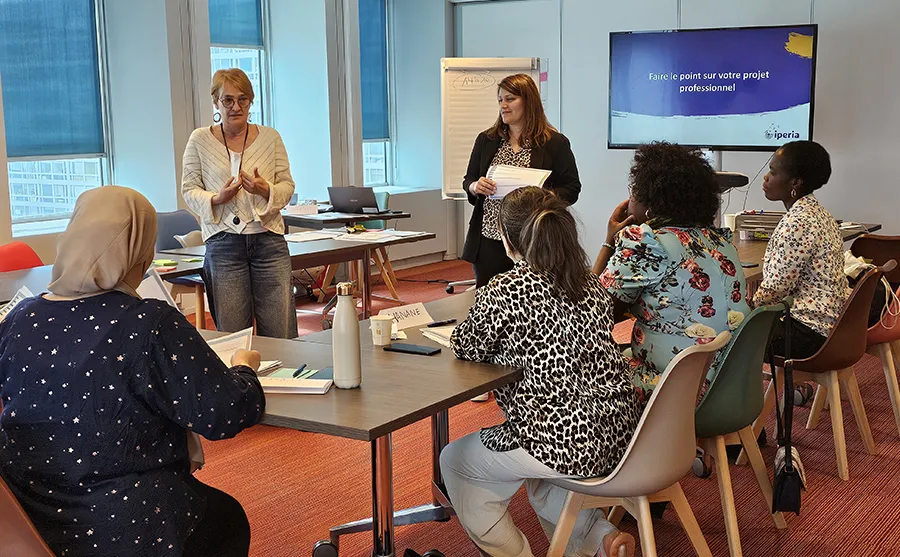
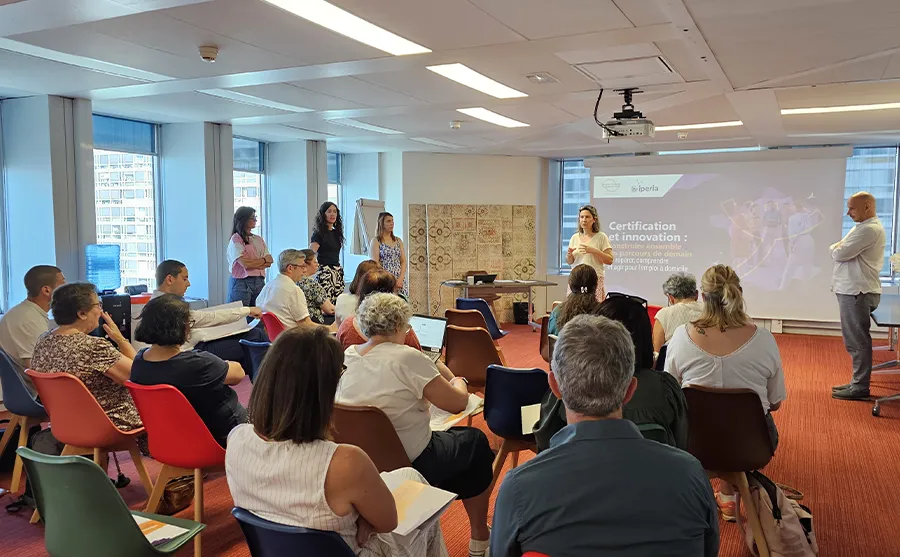
Against this backdrop, IPERIA organised regional meetings in May and June with its 230 partner training organisations, both in person and online, throughout France under the theme: "Certification and Innovation: Building Tomorrow's Career Pathways Together."
These sessions go far beyond traditional information meetings. They provide opportunities to test ongoing developments against real-world practice through workshops, discussions and experience sharing. Training organisations are recognised as genuine partners whose feedback directly shapes tomorrow's certification tools. Discussions covering the sector's three major fields—family support, early childhood and ageing at home—draw upon occupational studies conducted by IPERIA, acting on behalf of the professional branch, with more than 4,000 sector professionals.
These sessions go far beyond traditional information meetings. They provide opportunities to test ongoing developments against real-world practice through workshops, discussions and experience sharing. Training organisations are recognised as genuine partners whose feedback directly shapes tomorrow's certification tools. Discussions covering the sector's three major fields—family support, early childhood and ageing at home—draw upon occupational studies conducted by IPERIA, acting on behalf of the professional branch, with more than 4,000 sector professionals.
What Training Organisations Say—and What They Expect
Feedback regarding collaboration with IPERIA is remarkably consistent: "It has always been easy to get in touch, whether by phone or email." "I really appreciate the online platform where everything is available—it's simple and practical." Such feedback is particularly meaningful in a sector where training organisations perform multiple roles simultaneously: trainers, assessors and local partners.
Their expectations also provide a roadmap for future support. They are looking for tutorials explaining remote assessment procedures, videos showcasing career opportunities and greater visibility across social media. In response, IPERIA is currently developing a digital resource for assessors, which will be accessible through iperia.eu. Regular sharing of sector data is also being considered. These discussions confirm an essential point: explaining certification—its evolution, objectives and tools—is just as important as certification itself. Pedagogy is not an additional element; it lies at the very heart of IPERIA's mission.
Their expectations also provide a roadmap for future support. They are looking for tutorials explaining remote assessment procedures, videos showcasing career opportunities and greater visibility across social media. In response, IPERIA is currently developing a digital resource for assessors, which will be accessible through iperia.eu. Regular sharing of sector data is also being considered. These discussions confirm an essential point: explaining certification—its evolution, objectives and tools—is just as important as certification itself. Pedagogy is not an additional element; it lies at the very heart of IPERIA's mission.
Micro-Credentials and Skills Passports: Looking Ahead
The regional meetings also provided an opportunity to share ideas that are still under development. Micro-credentials, designed to meet growing demand for more flexible and agile learning pathways, are currently being tested through MyCred4Home, a European project led by IPERIA in partnership with the professional branch. At the same time, work is underway on a Skills Passport, conceived as an updatable record of professional achievements that would support employees throughout their careers.
Behind these developments lie months of collaborative work and a shared ambition. As Camille Savre, Head of the Professional Occupations and Certification Engineering Department, explains: "After 18 months of work, these regional meetings represent the culmination of our engineering project. They allow us both to present the work that has been carried out and to strengthen our relationships with our partner training organisations while handing over the new certifications that they will now deliver. Receiving their feedback is extremely valuable, and launching these new learning pathways is tremendously exciting."
Behind these developments lie months of collaborative work and a shared ambition. As Camille Savre, Head of the Professional Occupations and Certification Engineering Department, explains: "After 18 months of work, these regional meetings represent the culmination of our engineering project. They allow us both to present the work that has been carried out and to strengthen our relationships with our partner training organisations while handing over the new certifications that they will now deliver. Receiving their feedback is extremely valuable, and launching these new learning pathways is tremendously exciting."
Are you one of IPERIA's partner training organisations?
Access all the resources and tools available in your dedicated Training Organisation portal.
Access all the resources and tools available in your dedicated Training Organisation portal.